My grandfather, Albert Elmer Rundle served in the Canadian Machine Gun Corps during World War I.
He wrote his parents regularly over the course of his service. These letters somehow were passed down within the family. Recently, I began scanning them, and became curious about the context and the obvious ‘white spaces’ of the gaps between each letter. So I began, a bit obsessively, to look into where he served and what he did while he was there. This account is the result.
Although later known to all as ‘Dad’, my Grandfather went by Elmer in those early days – for brevity I will use AER. In this account, place names which are CAPITALISED indicate exact places where his letters or the Canadian Corps’ war diaries indicate that his Company was posted or passed in transit.
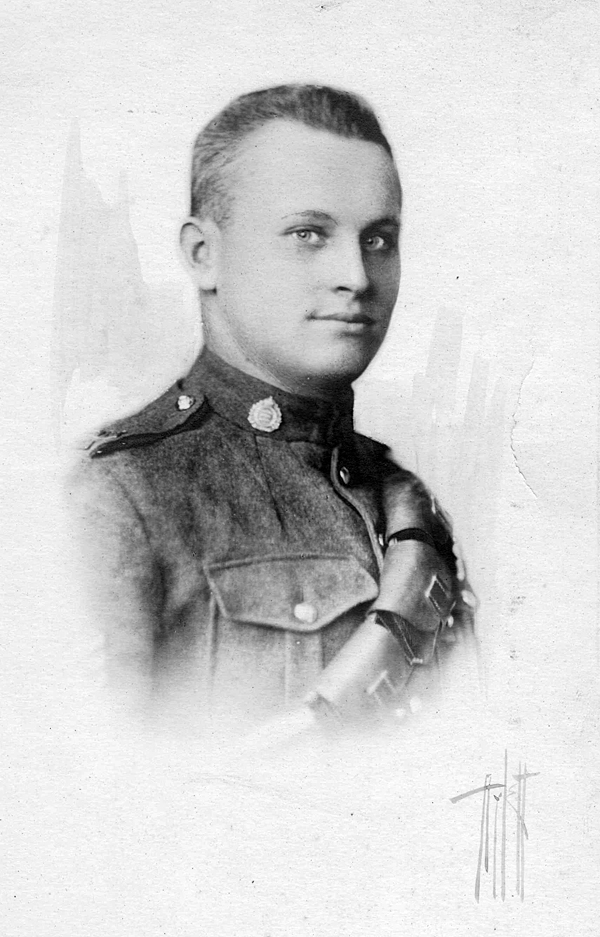
London 1917
Albert ‘Elmer’ Rundle
A.E. Rundle was born in October, 1892 in Courtice, Ontario. He grew up on his parents’ farm, but had no great love of farming as a career. He moved to Toronto on completing High School in 1909. He was hired by the North American Life Insurance Company as an Insurance Clerk.
At some point prior to 1914, AER spent nine months in the Queens’ Own Rifles as a reservist. However, he only enlisted – with the Canadian Cyclist Corps – at Toronto on May 4, 1916. This was fairly late in the enlistment game: the patriotic fever which saw many young men rush to the Army at the outbreak of war had waned, and the numbers of young men presenting themselves at the recruiting depot were alarmingly low. In desperation, the military was imploring businesses to release young men who had been exempted from war service. It was common for suitable-looking men to be stopped on the street by Army recruiters and implored to enlist.
Elmer Rundle’s enlistment received final approval on May 19, 1916. He most likely reported to Exhibition Camp, at the Colliseum Buildings at the CNE, where most Toronto area recruits were mustered. He received his non-commissioned officer training that fall, at the Stanley Barracks at the CNE. In those days, recruits were sent to a camp in Niagara after their basic training, and then were moved to Halifax to board troop ships to head to England.
By the time he was ordered overseas, AER had been promoted to the rank of Sergeant.
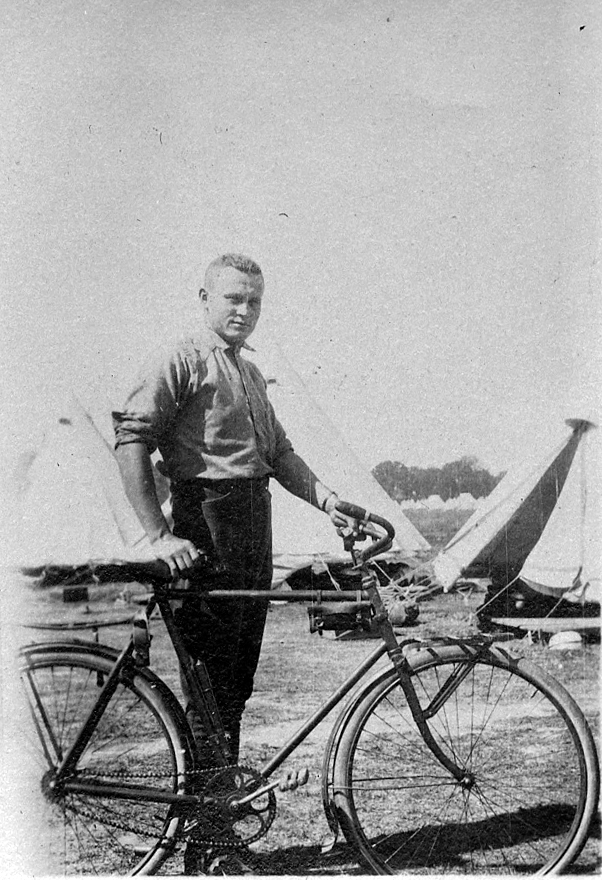
The Cyclist Corps recruit, likely at Niagara Camp early in his service
En Route to the War
AER’s last letter home from Toronto was dated April 19, 1917. He left for Halifax shortly afterwards.
April 30 , 1917 – Windsor Jct, NS
“We have been anchored here since Sunday morning, with a whole bunch of other troops. There seems to be a congestion at Halifax….We have not made good time…Saturday night we stopped over an hour or so in Monction and marched through the streets behind the town band. They gave us quite a reception.”
The train on which he travelled to Halifax functioned as a wheeled barracks until his troop ship was ready to take passengers. The ship may have been the SS Justicia, which sailed from Halifax on May 5, 1917. RMS Olympic also sailed from Halifax around this time. Sailing orders and passenger lists are not online, but are apparently available at the National Archives in Ottawa.
Aboard the Troop Ship, prior to sailing
“Electric lights, a steward to shine your boots and even an electric fan in the room. How does that get you? And even at that we are only travelling second class, so you can imagine what the boat would have been if it were not a troopship”
Training … and Waiting… in England
On landing in England, AER was initially sent to the Canadian Reserve Depot in CHISELDON, where the Canadian Cyclist Reserve Company was stationed. This was a former British Cavalry base, where newly arrived reinforcements were trained while awaiting the call to proceed to France.
June 24 1917 – Chiseldon, England
“On the whole, we like our work very much. Besides our cycle drill we get musketry bombing, signaling, etc which will be very interesting when we get into it”
Cyclist casualties were not heavy, especially among Sergeants. AER found himself passed over for the draft platoons of replacements being sent to the front. The tedium wasn’t pleasant, but there were worse fates.
June 24 1917 – Chiseldon, England
“I have been thinking of trading in (my sergeant’s stripes), because I don’t want to stick around here with nothing to do, and then I might be able to make the next Cyclist draft for France….I may work my transfer to the Artillery or Cavalry, but won’t do anything on my own until these (remaining infantry-assigned soldiers awaiting posting) get away, because if you let them think you aren’t going to stay here they will chuck you in the infantry and get rid of you, and I would sooner be with a mounted unit than in the infantry….meanwhile, I am doing nothing + working hard at it”.
July 20 1917 – Shoreham Military Base:
“We see a lot of aeroplanes here, the big warplanes. At night there are searchlights going up in all directions looking for enemy planes.”
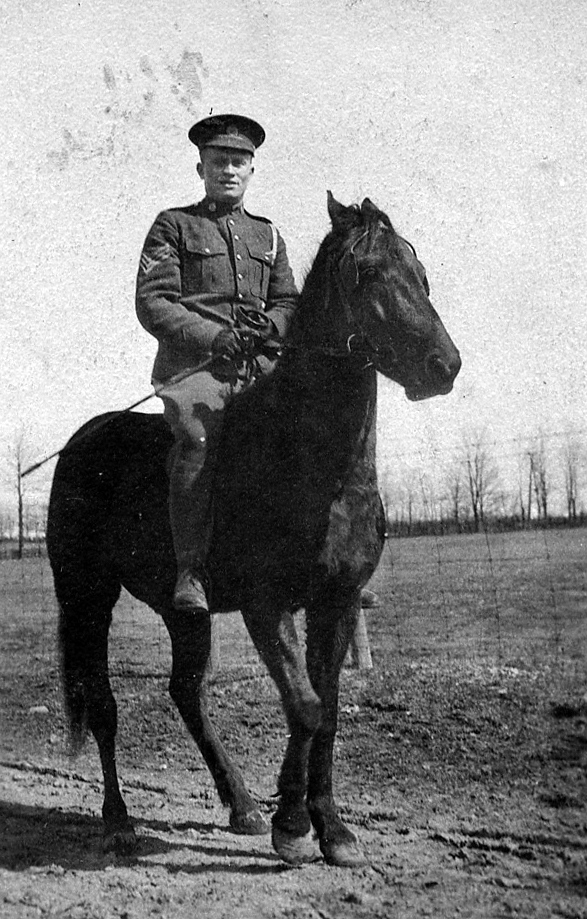
AER’s letters mention drills involving route marches on horseback. He is not wearing CMGC insignia, but has his stripes – so this is likely taken while in England in 1917, before his transfer to the Machine Gun Corps
Joining the Machine Gun Corps
At some point in the summer of 1917, Elmer was tapped, or perhaps volunteered, to transfer from the Cyclist Corps to the Machine Gun Corps, which had suffered much higher losses and consequently was in greater need of replacements. He did in fact give up his Sergeant’s stripes, reverting to the rank of Private.
By October, AER had transferred to the Machine Gunnery School in Seaford, where he had completed gunnery training and was waiting to be sent to an active unit in France. In early November, he was placed in a draft platoon and granted one final leave. On return from leave, he was to move to France.
Oct 17 1917 – Canadian Machine Gun Depot, Seaford
“We are only supposed to work in support lines, and the guns are all carried in limbers for us, so you can see it is considerably better than carrying a rifle + pack all over the place. If I can land a nice job riding a horse on the gun limbers I will be all to the merry.”
His last letter home from England, written at the end of his final leave, was dated November 15th, 1917.
Thurs Nov 15 1917– Seaford
“We returned from leave Sun Nov 11….Pretty busy since we came back getting moved to the Draft Company. When I go to France…I know the machine gun a little better now…. I will give it my best”
On the Way
In that same period in October 1917, the Canadian Corps undertook its infamous attack on the German line at Passchendaele. The heavy casualties incurred resulted in an urgent call for reinforcements: in November 1917, 9,783 Canadian Corps reinforcements were sent from England to the field units. AER was one of the almost ten thousand new troops sent to the front.
After Passchendaele, the entire Canadian Corps withdrew from the Ypres front to spend the winter of 1917-1918 near VIMY. Here, the Corps recovered from the its losses, while also protecting a less active sector of the front lines. During this period, the Corps spent considerable time improving the tunnels and trenches. This sector did not see major battles over the winter, but there were frequent raids and exchanges of gunfire across the trenchline.
AER was assigned to the 11th Company, Canadian Machine Gun Corps – a unit of about 300 men supporting the 4th Canadian Infantry Division. The 11th Cpy had withdrawn from the line at Ypres on November 15th, travelling by train and on foot back to the Vimy area. They arrived in BEUGIN on November 23rd 1917. Concurrently, AER crossed the English Channel to CALAIS and proceeded, likely on foot, arriving at the CMGC’s forward replacement depot at CALONNE RICQUART.
Friday Nov 23 1917 – France –
“We have been the last few days at the Reinforcement Base and are billeted at French houses…we have it very nice here, compared to what we had coming up the line”
“Tomorrow I have to do a guard…we will be here until we are called further up the line, which may be quite some time. Aeroplanes are as thick as flies around here. I saw one come down today. I wouldn’t care for that job. We can see + hear all kinds of doings from here.”
AER, along with 26 other replacements, reached the 11th Cpy in their billet at BEUGIN on November 27, 1917. For those last days of November, and into December, the Company drilled and trained, bringing the new replacements up to speed in preparation for a return to the line.
The Company’s war diary for November 28-30 1917 notes:
“The afternoons were given up to sports”.
Sunday Dec 2 1917 – France –
“Most of the time around here is taken up by shining up your equipment etc. They are more fussy over that than they are in England, + that’s saying a lot. They are always pulling off inspections + all that kind of thing to make sure you aren’t idling away the shining moments.”
“The chaps here say it’s bad policy to get yourself used to a flashlight but I would have certainly have broken my neck already without one.”
“You don’t see many horses out here. They are mostly mules. We have lots of mules in our outfit. I don’t now where they come from”. (Note: Machine gun units maintained two means of transport – horse drawn gun mounts (“limbers”) and pack mules. The gunners switched to the mules in the trenches where mud and terrain prevented the use of horse drawn limbers.)
“We vote tomorrow in the elections. I guess we will give old man Powell a shot at winning the war. You would be surprised at the number of chaps who aren’t in favour of conscription. I don’t think much of it myself….if we only had those lousy Russians out of the way and a few good gaps on that front we could get it over in about 15 minutes.”
Clearly, the reality of trench warfare was only just sinking in to the newbies.
On December 6th, the Company marched to OURTON for inspection by the Canadian Corps’ Commanding General, Sir Arthur Currie. After the inspection, which took place on December 7th, they returned to their billets.
Monday Dec 10 1917 – France
“You get issued with about one (envelope for mail) every month. All other mail has to be censored by your own officer, which in my case happens to be your cousin Roach. He seems to be popular with the boys + I think will be a good man. Of course it is a little galling sometimes to be a buck private when so many others have been a little luckier, but that’s part of the army. They are all the same out here anyway, and believe me an officer’s life is no tea party.”
(note – Lt Roach arrived with AER as a replacement officer. He is mentioned frequently in the war diaries, and his name will appear again later on)
“We were paraded for a bath on Saturday (note – this event appears in War diary – Dec 8th, , as a march to HOUDAIN for bathing parade) , the second we have had since we came across. ”
“By means of a little diplomatic dickering with a French dame here another chap + I have a nice little room + a real bed to sleep on at nights. A good one, too. How is that for up here? It won’t last forever, but it has been two weeks already, and every little bit helps.”
“We see some great aeroplane stunts here. Occasionally a Fritzie comes over, but the ones we see are mostly our own. They do some great corkscrew dives I can tell you. I have no desire to be an aviator.”
“That was an awful affair in Halifax, according to reports. Must have been some Hun at the bottom of that.”
Tuesday Dec 11 1917 –Continues
“Everything is fine here + likely to be pretty soft for the winter months, so there is nothing to worry about at all.”
Monday Dec 17 1917 – France
“The other day I walked over and saw Geo Stainton. He was only 4 or 5 miles from where I was then. I found his outfit getting ready for all kinds of inspections, and believe me it’s some job with them, where they have all the horses + guns etc. They certainly are a hard-worked bunch + I think I would just as soon be where I am. George has one stripe now so he is quite an official. I hope I never get any more of those things they only get you into trouble, especially one or two. I have had a far better time since I got rid of my three.”
On December 17th, the Company marched from BEUGIN to CARENCY, positioning to reenter the line. AER’s letter of December 17th was the last he would write until May – or perhaps, his family chose not to preserve his letters from that period. Certainly, their tone would have been different : he was at the front.
And So It Begins – Winter 1917/1918
On December 17th 1917, the 11th Company entered the line near CARENCY.
AER’s first taste of the front was short and uneventful, lasting only two days. On December 19th, the Company was relieved and moved to reserve positions behind the trenches.
On December 23rd, a test drill was run to practice a quick entry to the trenches.
The Company’s war diary reports that Christmas was quiet:
“No drills were carried out, the day being spent in preparing the huts for Christmas dinner – at which, owing to the generosity of societies and individuals in Canada, it was possible for every man to have a Christmas parcel.”
After the holiday, the Company took up positions in the line. They settled down to a daily routine: in daytime, conducting working parties, laying wire and reinforcing trenches and gun emplacements; and at night: standing guard, launching raids on the German lines and fending off German raids on their own positions.
- January 4th, 1918 the Company moved to AVION and entered the line. Construction work proceeded uneventfully until January 13th, when the Canadians undertook a raid of the German trenches. This would have been AER’s first experience under fire. Night firing continued until January 17th, when the Company was relieved and returned to CARENCY to rest, bathe, and collect pay.
- January 19th, 1918 – returned to the trenches near LIEVIN. Night firing, and skirmishes with German patrols, continued until January 25th.
- January 26th 1918 – returned to CARENCY for another cycle of bathing, rest, and reequipping.
On February 6th 1918, the Company returned to the rear trenches near LIEVIN, held in reserve. The Company was kept busy by plowing and planting fields with a variety of crops.
On February 12th 1918, the Company returned to the front trenches, and resumed night firing and sentinel duty.
- February 14th 1918, another raid was conducted; the enemy responded by firing with gas shells onto the trenches.
The Company withdrew on February 18th 1918, moving to billets at MARQUEFFLES.
The Company’s war diary reports that Private Rundle, among others, “returned to duty from tunnelling course” on February 20, 1918.
On March 11th 1918, the Company returned first to LEIVIN and then into the line at CARENCY. This was a quiet spell. The Company left the line on the 17th, moving to the HILL 70 area.
On March 23rd, the Company reentered the line at HILL 70. A very tense period of fighting began, with the Canadians conducting raids and night firing while bracing in expectation of an enemy attack. The attack never materialised. This tour ended on March 29th, when the company withdrew to billets at SPRINGVALE CAMP near ECURIE.
Reorganization and A Busy April
In World War I the 18 or so Companies of the Canadian Machine Gun Corps operated as freestanding units – assigned independently to support specific Battalions of the Infantry Divisions which made up the Canadian Corps. Each Company consisted of roughly 300 men, who were deployed alongside the infantry in the trenches with a separate chain of command. In early 1918, this organization was changed to better integrate machine gun tactics with infantry operations in the trenches. The Companies were consolidated into four Batallions, one for each of the four Canadian Infantry Divisions.
On March 28 1918, the 11th Machine Gun Company became the No 2 Company of the 4th Canadian Machine Gun Battalion. Roughly 50 soldiers were drawn from each existing Company to form additional new Companies.
The war diaries, and the details of AER’s letters, suggest that he remained with No 2 Company, but it is possible that he in fact moved to No 3 Company. Until WWI Service records have been fully digitised by Collections Canada, this can’t be confirmed – but I have documented on the assumption that AER served with No 2 Company.
In any event, on March 30th the entire 4th Machine Gun Battalion returned to the line near GAVRELLE.
April 1918 was a long month spent in the trenches, with continuing trench warfare under constant artillery barrages, with many incoming gas shells, aerial bombardments, and trench raids. A major Canadian raid took place on April 11th, leading to an advance in the line to NEUVILLE SAINT VAAST. Heavy fighting continued.
The war diary for a typical day in April states simply:
“Normal warfare. 32,750 rounds fired”.
May to July: Rest and Recuperation
Finally, on May 5th 1918, the 2nd Company was relieved and proceeded by motor transport to AVERDOINGT to rest and reequip.
On arrival, some good news was waiting for Private Rundle: he had been promoted to Corporal effective May 1, 1918.
May 10 1918 – France
“ Just now we are comfortably settled in a billet at a farm. We have a nice place in a barn with plenty of straw, and now that the weather is good we enjoy it very much.”
“We have been doing a little drill and shining again the last few days, but it isn’t so bad for a change, especially since such a long siege of it. It is certainly nice to get some eggs + chips occasionally.”
Training continued through May. Time was divided between drilling and football matches. The Company marched to TINQUES on May 14th for baths. and then went on a route march on May 16th through MAZIERES, AMBRINES, VALERS SUR SIMON, PENIN, and back to AVERDOINGT.
May 14 1918 – France
“I had about six letters go asking at the same time. Don’t get uneasy if you don’t hear from me at any time. I always write regularly but … there are lots of chance for it getting held up or lost.”
“We are at the same place as when I last wrote you, and still getting lots of fresh milk and eggs. I manage to get away with a couple messtins of milk and four or five raw or fried eggs every day. We are getting fat now, and we needed the change at that.”
On May 23rd, the entire Battalion relocated on foot to MARLES LES MINES and resumed training. This occupied the Canadian Corps through much of June, as plans were laid for ambitious attacks later in the summer.
July 7 1918 – France
“We had the Canadian Corps sports on July 1st, and I managed to get out to them. They had a very fine day, and the best sports I have ever seen anyplace. They also had your friends the Duke of Connaught + R.L. Borden there.”
“They had a couple airmen doing stunts down there too, and one of them was the best I have ever seen. I have seen some pretty good fights and several come down, but this had it on them all. Every time he dived the crowd would duck to get out of the way.”
“I could use some razor blades. I have the same razor I have had for years, and I have been very lucky so far never to lose my razor or my watch. I have lost two packs and a greatcoat, and I don’t know what else, but as long as you have a razor, toothbrush and a watch you are well away. The old clock never misses any ticks either. Several times this winter and spring it was the only timepiece on the crew.”
“I was talking to Mr Roach yesterday. He was just going on leave to England. I came to the Company the same day (as Roach did), but I won’t go on leave for months yet. Sometimes it pays to be an officer.”
The Pace Quickens
This peaceful if hard-working period ended on July 11th, when No 2 Company marched from MARLES LES MINES to CALONNE RICOURT, entrained for the trip to MAROEUIL, and marched to ECURIE, where they remained overnight.
On July 12, after camping beside the LENS-ARRAS ROAD, they proceeded into the line. Periods of fighting – some light, some heavy – continued until the end of the month. Soldiers rotated in and out of forward positions; those not committed to the trenches continued with training and drills.
July 14 1918 – France
“The box of Laura’s (Note – Secord Chocolates) sent May 25th came the night before last, and at a very welcome time. They were in good shape too, and I can tell you they didn’t last long. A plain label would be better. Anything with Chocolates etc on the outside is too tempting to be safe, and they are too good to waste on mail clerks.”
On July 17th, the base camp was moved to a point between ANZIN and MADAGASCAR CORNER (a road intersection) due to enemy aircraft having spotted the camp, which resulted in the camp being targeted by long range German artillery.
July 19 1918 – France
“I received the parcel sent June 12th last night. The box was all in good shape, and is almost gone already. You said something about being in a place where I could enjoy it. I never was in a place yet where I couldn’t enjoy the contents of a box. Anyways this happens to be an exceptionally good place. For a few days I am taken off the gun for some other work which is a very nice change.” (NOTE: At some point in his war, AER was wounded in action. While he never tells his family about this, I suspect this is the point in time where that happened.)
On July 31 1918, the 4th Battalion received orders to move in secrecy to a postion east of Amiens. Something was brewing on the front.
Canada’s Hundred Days Begins
The period from August to November 1918 has been named the Hundred Days, marking a period where the Canadian Corps fought a series of successful battles. This action broke the Western Front out from its longstanding stalemate. The attacks breached the German defensive lines, significantly weakening Germany’s military strength, and contributing to the momentum that led to the Armistice.
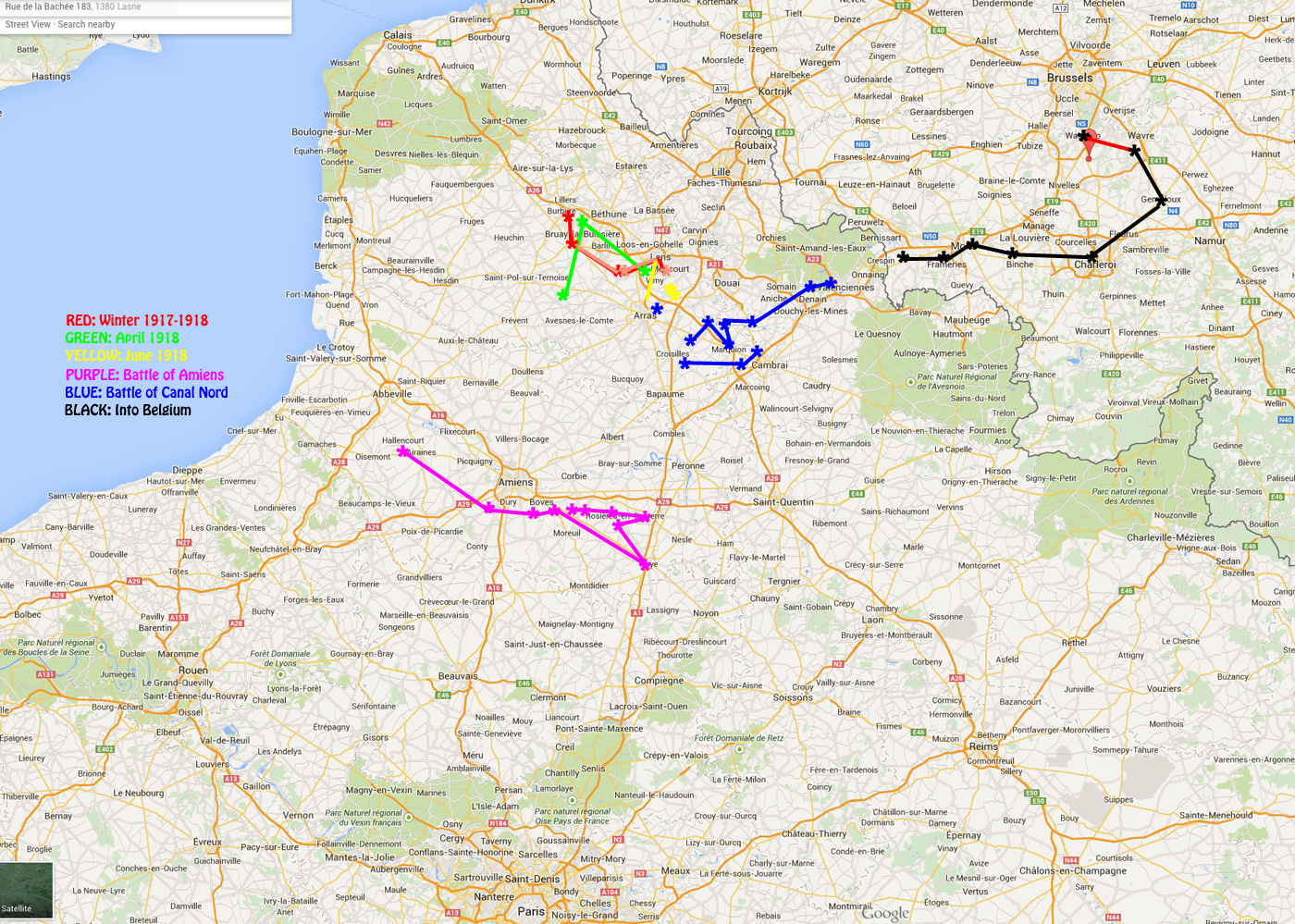
The Hundred Days opened with the Battle of Amiens, which began on August 8th 1918 and lasted until the end of the month. AER’s Company was one of the many units fighting in this battle. His unit’s movements during the battle are listed below. Given the scale of this battle, it’s hard to infer exactly what his role was at any given time: he would have been in and out of the thick of the action the whole time.
- August 3rd – left ANZIN on foot, boarded busses at WARLUS, travelled overnight arriving at FORGEVILLE in the early hours of August 4th
- August 4th – left FORCEVILLE at 19:00, marched to ALLERY, camped overnight
- August 5th – moved overnight to RUMAISNIL
- August 6th – moved overnight to the concentration area in FORET DE BOVES (Southwest of Amiens)
- August 8th – Zero Hour – advanced on the attack from FORET DE BOVES to DODO WOOD (sic) to DOMART-SUR-LA-LUCE to BEAUFORT-EN-SANTERRE to ROYE
- August 9th – moved to HOUGES, his Division was the spearhead unit for a major attack the next day
- August 10th – a forward attack, advancing to the road between CAIX and LE QUESNEL
- August 11th – holding defensive positions against enemy counterattacks
- August 12th – advancing CAIX to ROSIERS-EN-SANTERRE to CHAULNES (Hill 100)
- August 13th – withdrawing from the line to CAIX, brief period of rest
- Aug 15th – returning to the line from CAIX, moving forward aggressively. This was the heaviest period of action for AER’s unit, which encountered stiff resistance and repeated gas attacks. The unit reached ROSIERS on August 17.
- After reaching ROSIERS, the unit held the line against enemy resistance, until August 24th when the unit was relieved and moved to HANGARD
- August 25th – withdrew to GENTELLES
On August 28th, having completed its mission in the Amiens sector, AER’s Battalion moved back to the VIMY sector from GENTELLES, travelling by rail from LONGEAU to ACQ, then by lorry to WARLUS. On Augsut 29th, the unit had moved to a concentration area east of ARRAS.
The second major battle of the Hundred Days, the Battle of Canal Nord, began on August 26th, just as the 4th Division arrived back in Vimy. AER’s unit joined the Canadian assault on August 31st, just in time for an enemy counterattack on September 1st.
- September 1st – to CAGINCOURT, then VILLERS LES CAGINCOURT
- September 2nd – attack on BLECOURT-OVILLERS, then attacking DURY RIDGE to the CANAL NORD, to SAUDEMONT, to RUMEAUCOURT, to ECOURT-ST Quentin, to LECLUSE
- September 4th – relieved overnight, move to INCHY and AGNY CHATEAU to regroup
- September 8th – to ANZIN
- September 14th – move to AGNEN LES SUISANS to MARQUION, arrive and take billets at ECOURT ST QUENTIN, begin rest and training
- September 19th – back into the line, advancing from BUGNICOURT to AUBERICOURT to HAVELUY to AUBRY to RAIMES, where the attack halted
- September 21st – withdraw to NEUVILLE VITASSE
- September 22nd – withdraw to south of ARRAS
- September 25th – held in reserve at ROUVILLE ST VAAST, move to staging area at BULLICOURT
- September 27th – the major attack on BOULON WOOD begins, continuing until the 29th, reaching as far as FONTAINE-NOTRE-DAME then concentrated near RAILLENCOURT; capturing SANCOURT and entering BLECOURT, driven back to SANCOURT
- September 30th – again attacking and capturing BLECOURT, but again pushed back to SANCOURT
- October 1st – again attacking, but suffering heavy casualties. The Battalion takes up defensive positions south and east of SANCOURT, expecting the enemy to launch a further counter attack in strength. Instead, the enemy withdraws and the battle draws to an end
- October 2nd – Company withdraws and assumes billets in INCHY-EN-ARTOIS
- October 7th – Company relocates to billets in ANZIN
Between August 8th and October 1st, the Canadian Corps suffered 31,000 casualties – about 30% of its overall strength. On October 3rd, 1918, AER was promoted to Sergeant.
Oct 13 1918 – France
”I notice what you say about the applesauce + cream we had in the summer. We haven’t run into any apples lately. The cream we get here is the canned variety. They don’t supply us with any cans.”
“We have a comfortable place here just now in a small town. We have a YMCA here and some canteens, so everything is lovely.
”If I am lucky enough to get leave in the next month, (the underwear you sent me) will be just the thing for England”
While AER’s unit enjoyed a week of rest, the attack continued. By October 14th, the fighting had concluded around Cambrai and the Canadian Corps was advancing towards Valenciennes. After a week’s respite, AER’s unit went back into the front line.
- October 14th 1918 – The Company marched to AGNEZ LES DUISANS, entrained and rode to MARQUION/SAUCHY LESTREE, marched to billets at ECOURT ST QUENTIN
- October 16th 1918 – into the attack, crossing the river on the evening of the 17th, halted by enemy resistance east of DENAIN
- October 18th 1918 – advanced through BUGNICOURT AUBERCHICOURT HAVELUY and RAISMES
By October 21st 1918, the Company was paused in the towns of AUBRY-DU-HAINANT, RAIMSES, BEUVRAGES, and OISY. This was just a short regroup, while a strategy was devised to enter the town of Valenciennes. But the halt was long enough for AER to qualify for leave.
On October 24th 1918, AER left the battlefield, and returned to England, with most of the remaining soldiers in No 2 Company.
I have wondered why so many would be granted leave while the battle was still continuing. The records show that No 2 Company was pulled out of the line and granted leave as a unit: a half dozen officers, and a large number of Other Ranks, went on leave at this time. No 2 Company does not appear in the war diary for the next couple of weeks. A draft of 78 new reinforcements – roughly 25% of the Company’s full complement – reached the 4th Battalion on October 28th. One suspects that the unit had suffered heavy losses and was no longer fit for action. While many remained in France, for AER, it was a timely end to the action.
On Leave
By Nov 2nd, AER was in Glasgow Scotland, having arrived from Edinburgh.
Nov 2 1918 – Glasgow, Scotland
“We came across yesterday from Edinburgh. I am quite happy, whether I am seeing any sights or not. I didn’t come across here for sightseeing this time, just for a change of air”
Nov 7 1918 – London
“We spent three very fine days in Glasgow”
”We came back to London yesterday from Nottingham, where we had spent a couple days.”
Nov 10 1918 – London
“This is Sunday night about 9:30 and I have to get all my stuff together and get down to the YMCA where I am sleeping tonight near Victoria Station.. We have to get down there handy so we can be called in the morning as we have to report at the station at 06:30. “
“The people here are in a state of feverish excitement waiting for the answer to the Armistice terms. They have until eleven tomorrow…”
“Yesterday I ran into your cousin Lieut Roach. He was hit in the thigh and one finger, but he is almost well again now, although still in hospital. He is near London and gets up here several times a week. He has never been able to get his kit over from France so he is running around in a suit of civvies, quite English you know. Needless to say he is well out of it. He is one of the very best and I have always thought a lot of him.”
AER’s leave expired on the morning of November 11 1918, three and a half hours before the Armistice deadline. He arrived by train at Dover, about to transfer to the boat to Calais, when the Armistice was announced. It was his lot to return to France. While he was away on leave his Company had continued to fight, and then withdrew to ST WAAST LE HAUT to regroup. They were already in reserve when the guns stopped firing.
After the Armistice
On November 14 1918, the 4th Machine Gun Battalion moved from ST WAAST LE HAUT to ONNAING. The following day they moved to DOUR in Belgium and billeted there. Somewhere along that route, AER reported to his unit.
Nov 18 1918 – Near Mons, Belgium
“Just now we are billeted in a nice clean Belgian town near Mons…We left London on the 7 AM train last Monday morning. We were almost staying over a day or so, and could have got away with it OK, but we weren’t sure whether (the Armistice) was coming off, and we figured that even if it did happen we would be better off in France than drilling our heads off at some reserve in England. We were just at Dover going to get on the boat when she blew up. It was some time for an hour or so.”
Anyway we came on over, and it took us a couple of days (from the 11th) to find our outfit. They were there where we left them at Valenciennes and preparing for the long march to Germany…. I was lucky to be on leave to miss one good trip over the top the last few days. I have done all of that stuff that I want to do.”
“The chaps can scarcely realise it even yet, except that we don’t hear the guns. We have got so used to listening for the shells coming that we cant understand it is all over. It seems strange to be able to travel anywhere in daylight. We always did all our moving at nights. It is strange too not to have to hide the lights for fear of bombing planes. I guess we will get used to it all after a while. Just now we seem to be walking on air.
I got the parcel from the Ladies Club, and it was fine too. You can imagine what it would be like after a ten day trip up the line with no rations and no place to sleep except what you could rustle for yourself.”
On November 19th, the unit moved again to FRAMERIES, and took up billets. They remained here until December 12th, cleaning and maintaining weapons and equipment, and enjoying sports and other recreational activity. In anticipation of the return of the unit to Canada, a vocational education program was initiated to train the men for civilian roles.
On December 12th, the Battalion began a series of marches, billeting overnight
- Dec 12th – to THIEU
- Dec 13th – to CHAPELLE-LEZ-HERLIAMONT
- Dec 14th – to RANSART
- Dec 16th – to GEMBLOUX
- Dec 17th – to TOURRINES ST LAMBERT
Dec 15 1918– Ransart, Belgium
“We are on the move all the time now. I am on the billeting party, and it isn’t any easy job either when we are moving every day. However we get a ride in a lorry all the time and the others have to march, so that helps some. We are always one day ahead of the rest…. I am on this job because I can handle the lingo a little, but it isn’t always a very nice job when you can’t get the kind of billets you want. You are given a certain street or area to put all your men in, and sometimes you are lucky and sometimes you aren’t.”
”I usually land in pretty soft myself, because I get a chance to look them all over. I have always managed to get a bed so far.”
December 19 1918– Tourrinnes St Lambert, Belgium
“We marched two days ago after I wrote last, and now we are well settled down in this town here, apparently for some weeks, or for Christmas at least. This is a very quiet town, and badly spread out which makes it hard for billeting. The young lady here plays the piano nicely.”
After the New Year, the Battalion shifted for the final time, moving January 3 1919 to OTTIGNIES and on January 4th to PLANCENOIT. The following months were spent mostly turning in equipment, conducting vocational classes, and sports. On February 2nd, AER received “Artificial Dentures” – whether that was the result of combat injury, an accident, or sports injury is not recorded.
In mid March, the 2nd Company was detailed for some time to NAMUR, to guard dumps of captured German military equipment. AER appears to have billeted in JAMBES – the War Diary comments “the billets were very poor”. The detail returned to PLANCENOIT on April 18th. By this point, all concerned were focussed mostly on coming home.
April 9 1919 – Jambes, Namur, Belgium
“I note what you say about the soldiers voting in the booze again. I don’t think there is much fear of that. I wouldn’t vote for it myself anyway. You don’t want to let all this talk and gossip about returned soldiers get under your skin. They may be rather useless for a few months, but most of these people who are complaining about them wouldn’t have cared to follow them across France.”
April 12 1919 – Plancenoit, Belgium
“Well here we are back in the old spot again. We came back here yesterday from Namur, having been relieved by Imperial troops. We got a great reception when we got back here….you would have thought it was their own sons coming back. We have been eating ever since we got back here.”
“I was rather amused at what you had to say about my coming home + getting married. If I had had any possibilities in that line I would certainly never have come to France. As far as your wishes are concerned I always like to be obliging, but a proposition like that is out of my line for the time. I always imagined these things just naturally happened. I was very pleased to hear that Edna is to be married shortly. I know the chap quite well, and he is a very fine fellow. He has a young family too, and he will get a mighty fine wife to look after them and any more that may arrive. Edna has been awfully good to all us chaps, especially the ones who have been over here, and we all think a great deal of her. As far as my being interested personally, or ever have been, I think you know better than that.”
April 20 1919 Plancenoit, Belgium
“We are getting good weather here, and we don’t have any difficulty in passing the time…. Last week the other chap and I took a run down to Torrinnes where we were at Christmas. They gave us a great time for a couple of days… Today was Sunday, and we had dinner with the family. They use us very fine. We will certainly be spoiled.”
Saying Good Bye
AER’s final departure from Plancenoit took place in early May. By May 19th, he was back at BRAMSHOTT DEPOT, a major military base, in England.
May 19 1919 – Bramshott Camp, England “
We have been here now just a week…we were only two days coming back…we had to be in London for a march past, so they rushed us right off the train on to the boat.”
“We got a good look at the King as we marched past him. He is quite gray now, and looks a lot older than when I saw him a couple years ago.”
”Since we came back from London we have been kept pretty busy with parades, inspections, medical boards, etc and we are far from finished yet…. It is far more trouble to get out of the Army than it was to get in. There are more papers to be filled out than we have ever seen in all our days of soldiering, and every few hours you have to pass three or four more doctors. If they find anything wrong they send you up for a long board, and you are liable for this country for a couple of months.”
”We will be the last of the 4th (to return to Canada) so there is plenty of time.”
“I had a letter from Wardie the ther day. I think they are still taking the place at the Island (Note: Ward’s Island, where AER had lived before the War). I figure on spending some time there this summer. It will seem great to be back, but there will only be a couple of us left.”

These men all wear CMGC insignia, and AER (seond from left, top row) has his stripes…so I am inferring that this photo was taken at Bramshott, just before repatriation.
AER drew his final pay at Bramshott Base on May 30, 1919. The name of the troopship that brought him back to Canada is not known.
His discharge papers were issued in Toronto on June 16, 1919.
Reprise
AER returned to Ypres and Belgium in 1957. He reconnected with the Belgian family in whose house he had been billeted in 1919. Among his papers is a letter written to him afterwards by his former host. The address, 183 Rue de la Bachee, Plancenoit, Belgium, is very likely where AER was billeted in Plancenoit. Rue de la Bachee has changed in the intervening years, and now ends around 125. My bucket list calls for further exploration at an appropriate time.

Vimy, Franch
1957
In his papers I also found a photograph of a young woman. The print is marked ‘Plancenoit’. but the name and address are otherwise: xxx Decarpentry, 19 Rue Victor Hugo, Haveluy Nord, France. The French census of 1910 shows a Decarpentry family – a family of chefs – in Haveluy; the census and various geneaology sites suggest the woman’s first name may be Germaine. If so, the same sites suggest she died in 1952, so there was not likely any reunion. What happens at the front stays at the front, I guess.
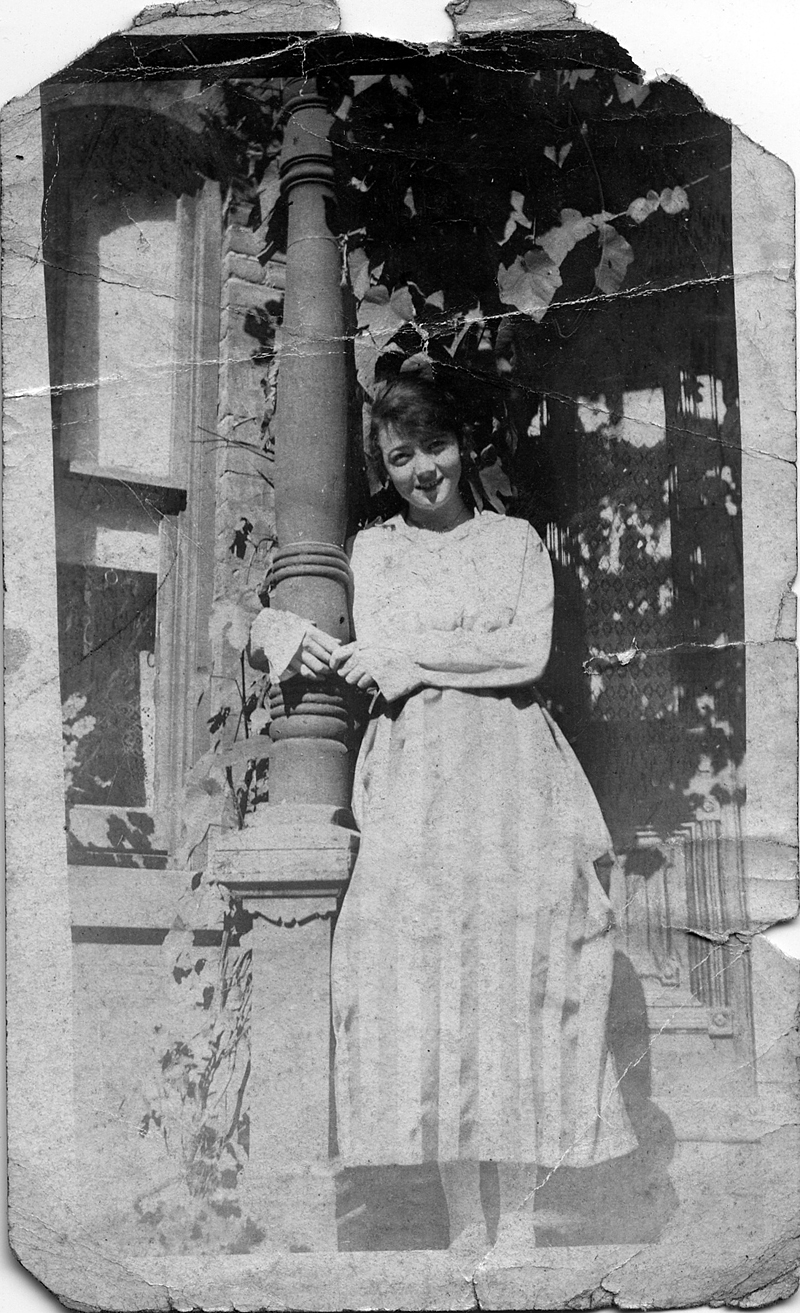
Mlle Decarpentry
Plancenoi, Belgium
1919
One family tale about my Grandfather concerns Veterans’ Day at the Canadian National Exhibition. Into the 1960’s, AER always turned out each year to parade with his old compatriots. The day also served as the annual Grandfather-grandsons’ trip to the Ex. It began with a sleepover at my grandparents’ house, where we rose early to find AER shining his medals and brushing up his old uniform beret and armband. The family headed down to the CNE grounds good and early so Sgt Rundle could catch up with old friends before the Veterans Parade. His young grandsons tolerated the parade, mostly because we knew it would be followed by exciting Midway rides and food treats.
After the parade, Gramps’ first order of business was always to head for the horse barn at the Colliseum – the sounds and smells and sights of horses was an integral part of his Veterans’ observances. Then, he would lead his grandsons to the Midway and cheerfully take them on whatever bone-ratting, stomach churning rides they selected. My grandmother watched anxiously as this elderly man, in his seventies and still wearing his best three-piece suit and tie, was spun and hurled and shaken from one end of the Midway to the other, for the pleasure of his grandsons.
I guess that having just revisited his memory of his wartime service, the roller-coaster ride would have seemed like a much more pleasant way to spend a day.
 Paul Cordingley
Hi Paul – Fantastic stuff on your grandfather! I would encourage you to join our group on Facebook, “Canadian Corps Cyclist Battalion Descendants’ Reunion”. We will be sharing news of efforts to honour the Cyclists in the coming years, and allowing the descendants of the Battalion to connect. I would also love to have permission to post your grandfather’s Cyclist photos there! Let me know.